Nobody Else Saw a Handbag in a Binocular Case. That Difference Is What We Build Courses Around.
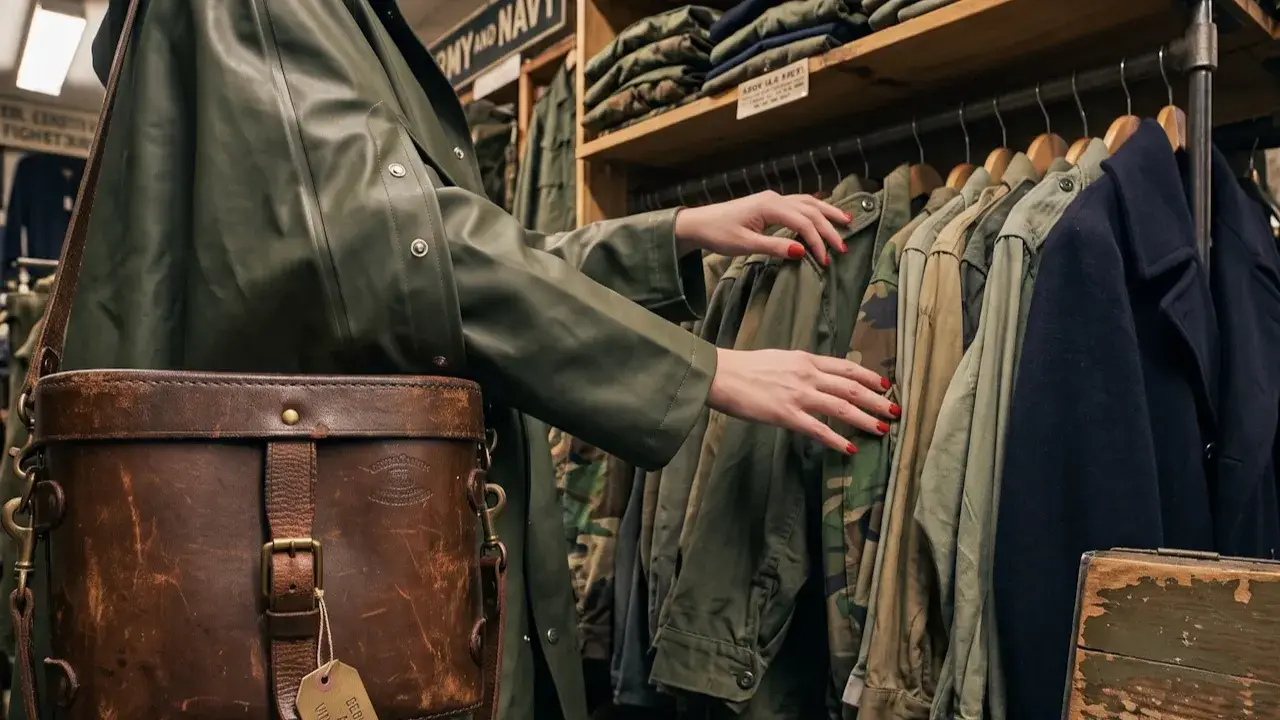
There was a time when I was in my twenties when every spare penny from my university grant went the same way: into the army and navy surplus store at Dudbridge on the edge of Stroud in Gloucestershire in the UK, where the racks were heavy with things that had been made for entirely different lives than the ones I was about to give them.
I would spend many hours with my boyfriend, working through the shelves, and what I was looking for was never obvious to anyone standing next to me, because a pair of old binocular cases did not look like a handbag to most people, and a naval uniform jacket did not look like something you would wear out on a Friday night, and a set of combat boots did not look like the kind of shoes a fashion student would choose over anything with a heel.
A rubber military cape, built for standing watch in weather nobody wanted to be out in, did not look like the answer to Gloucestershire rain to anyone who hadn't already decided it was.
That is the part of the story that mattered most, and it took me a long time to understand why. It was never really about the surplus store, or the particular decade of military stock sitting on those shelves, or even the money I didn't have to spend on anything more conventional. It was about a way of looking at raw material that most people simply do not have: the ability to stand in front of something that was built for one purpose and see, immediately and without much doubt, the entirely different and better purpose it was about to serve.
That skill did not stay behind in a surplus store in Stroud. It became the foundation of an entire career spent looking at fabric, silhouette, construction, and market, and seeing what other people walked straight past.
I think about those times when I go to sleep at night, because I spend most of my working life around people who have exactly the same skill, except the raw material they are looking at is not sitting on a rail in an old shop. It is inside their own heads, built up over years or decades of pattern cutting, buying, styling, teaching, or running a studio floor, and it is every bit as valuable as anything I ever found in a binocular case, and every bit as hard for most people to see the shape of on their own.
Expertise like that does not arrive pre-organised. It sits scattered across a career the way that shop floor was scattered across its shelves, in pieces that make total sense to the person who has lived through them and almost no sense at all to anyone trying to follow along from the outside, and that gap between what someone knows and what they can hand to another person is the exact gap that stops so many brilliant fashion professionals from ever building the course they keep meaning to build.
Turning a military jacket into something you would wear took more than finding it on the rail. It took unpicking, restructuring, working out what to keep and what to cut away, and stitching the whole thing back together around a shape that would hold when someone else put it on.
Turning years of fashion expertise into a course that another person can actually learn from takes exactly the same kind of work, and it is not creative work, not in the way that spotting the potential in a rubber cape was creative. It is construction work, the unglamorous kind, the kind that decides what stays, what goes, and what order a person needs to encounter it in if they are ever going to end up somewhere useful.
That construction work is what we do at We Teach Fashion, and it is the part of the process most fashion professionals never wanted to be responsible for in the first place, because they did not spend a career becoming brilliant at construction, editing, and course creation. They spent it becoming brilliant at fashion!
Our Catwalk to Commerce service exists for exactly that reason, so that the person with the expertise can keep doing the part they are actually good at and love, which is the sourcing, the seeing, the creative instinct that spots value where nobody else was looking, while we take on the collating, the structuring, and the building that turns all of it into a course somebody else can actually buy and finish. You bring the eye that found the handbag in the binocular case, and we do the stitching. You get to wear the finished thing, and you get to keep whatever it earns.
If there is a course sitting scattered across your own career the way that surplus store was scattered across its shelves, we would love to help you build it.
Read more about Catwalk to Commerce
Not Sure Where to Start?
Most of the educators I speak to have been thinking about this for longer than they'd like to admit. If that's you, a 30-minute conversation is often all it takes to get some clarity. I'll talk through your idea, your concerns, and whether now is the right time to move forward.
Thinking About Building an Online Course?
We write regularly about the real decisions involved in turning fashion expertise into online learning, what works, what doesn't, and what most people underestimate before they start. If you're considering this seriously, sign up and we'll send you practical, honest guidance as we publish it.
No noise. Just useful thinking for fashion professionals who are ready to do this properly.
We hate SPAM. We will never sell your information, for any reason.
Author