The Tailor Who Nearly Took It All With Him.
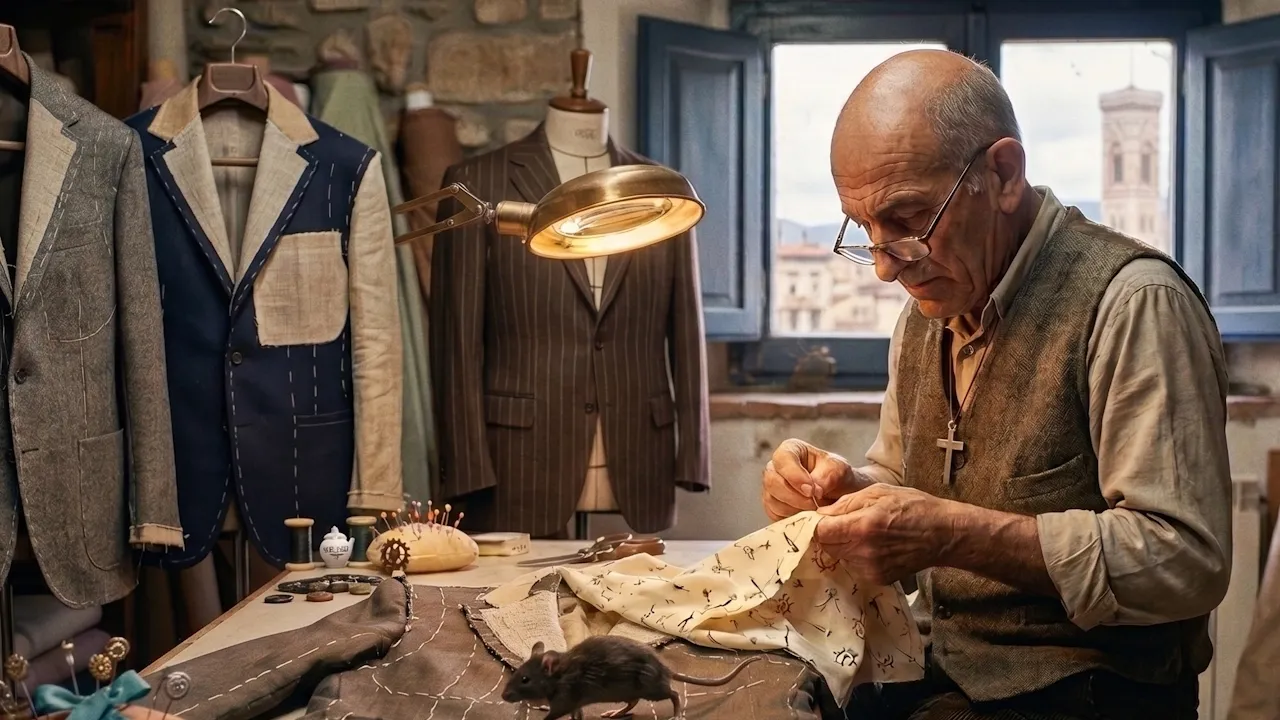
We want to tell you about a tailor. We'll call him Giuseppe; his story is one we keep meeting, in one shape or another, wherever we go in Italy.
Cutting cloth was the whole of his working life: not “in the industry”, but actually cutting it, with his own hands, in a workshop that always smelled faintly of chalk and steam. He had trained under a master tailor who had trained under a master before him, and none of it was ever written down, because nobody thought they would need to.
Apprentices came and went over the decades, as they do. Some stayed a season and moved on to Milan, to the bigger houses. A couple stayed for good, still at the next bench into their own middle age. Whatever they left with, none of them could quite put into words a feel for when a shoulder seam was out by half a millimetre, and little more explicable than that.
He was well past the age most people retire at and had, by most measures, done what he set out to do.
And still, he could not sleep.
It was not retirement itself that frightened him. He wanted it, and had earned it, dreamed of mornings with no tape measure anywhere near him. What kept him up was something else: the knowledge that when he pulled the shutters down for the last time, most of what was in his hands would go with them. A lifetime like his does not fit into a manual, and nobody had ever asked him to write one, so he would not have known where to begin.
People had suggested the obvious things. A university wanted him for guest lectures. A trade body wanted him on retainer. He turned both down, gently: the way one declines something well meant but wrong. He did not want a second career teaching. What he wanted was the rest he had earned and, at the same time, for the work to continue to matter after he had stopped doing it. The two things did not seem in any way reconcilable, as he could imagine.
That is roughly where we came in. He had heard, through someone who knew someone, of two British course designers who had ended up spending much of their lives in Italy, almost by accident, people who had sat with shoemakers in Le Marche, pattern cutters in Puglia, sustainability consultants in between, and had somehow made a habit of turning that kind of knowledge into something that outlives whoever is holding it.
We didnt speak with Giuseppe and try to persuade him to become a teacher. That was never really the task. But we did ask him to do the one thing he already did brilliantly, show someone how a garment should be made, and built the rest of it around him: the order things needed to happen in, where the material should live online, all the parts of “teaching” that have nothing to do with tailoring and everything to do with why so much of this knowledge dies with the person who holds it.
That is Tailormade one-to-one coaching in practice: not a course he had to build himself, but a way of drawing what was in his hands into a form that could stand up without him.
What came out the other end was a proper course, not a folder of clips loosely stitched together. A site that looked as though it belonged to a craftsman, why? Because it did.
He never had the long, quiet retirement he had pictured for himself. Not long before the course was due to go live, he was gone, and, unfortunately, what should have been his greatest asset was never published and now lives only as a memory.
For Those Who Want the Evidence
It would be easy to read this as a singular, rather pointless, sad story about one Tuscan tailor. However, we do not think it is. It looks far more like a preview of what is coming for an entire generation of people who know how to do things properly with their hands, worldwide and not only in Italy.
Italian manufacturing crafts have lost close to half their businesses since 1980, roughly 194,000 of them gone, a 46.2% decline, and the pattern repeats across ceramics, glassmaking, woodworking and tailoring: young people would rather work for someone established than open a workshop of their own, and the old masters cannot find anyone to hand the craft to. Tailoring specifically is shrinking at exactly the moment demand for it is returning; the number of tailors and alteration specialists in the US has dropped below 17,000, a 30% decline in a decade, with an average age of 54, older than the workforce around them.
It is not really a fashion problem. It is a knowledge problem, and there is decent research behind that claim. Michael Polanyi's work on tacit knowledge describes, almost exactly, what Giuseppe was carrying in his hands: knowledge that is personal, tied to context, difficult to put into words precisely because it lives in someone's own experience rather than on a page.
A recent study following craftsmen through this exact transition found much the same as we saw in Giuseppe: when skilled tradespeople talk about leaving their trade, they describe loss, not relief. Almost never relief.
There is also a fairly clear reason so few of these people get help in time. One review of the research on retiring experts points out that the easily codified knowledge gets codified, and the harder part judgment, instinct, the tacit knowledge mostly does not, partly because retiring experts can be wary of handing things to much younger colleagues, and partly because those colleagues are rarely trained to draw it out of them even when willing. The person with the knowledge usually is not a teacher. That, more than anything, is the problem.
There is a name, in the literature, for roughly what we did with Giuseppe: Nonaka and Takeuchi's SECI model, which describes how knowledge moves from someone's hands into something durable enough to survive them. It is tidier in the textbook than in practice, but the underlying point holds: most retiring experts get stuck at the very first stage, showing someone directly, one-to-one, because nobody has ever helped them do the next part, turning that demonstration into something that lasts.
Family businesses run into the same wall, arguably worse, because the knowledge and the relationships are tangled together. Research comparing two family firms across two centuries of succession found that handing over the intangible, practice-based knowledge of how a business actually runs mattered more to its survival than handing over the physical assets ever did. A 2026 study of artisan families in a UNESCO Creative City of Crafts reached a similar conclusion: the craft only survived where someone had made the handover deliberate. It did not simply happen on its own, however long the family had been at it.
None of this stays neatly inside Tuscan workshops. It is insurance brokers in Connecticut, foremen on Norwegian construction sites, tailors in Philadelphia who learned the trade from men who learned it as boys in Italy. Wherever real expertise has been built by hand over decades, rather than downloaded from a course, the same clock is running.
Most of these people will never write a book about it, or take up a place on the university circuit. They simply want to keep doing the work they love for as long as they can, and then, properly, stop. It is not only in Italy that we have seen this; the oldest version of this story we know did not happen in Italy at all, but close to where we grew up.
A Story We Grew Up With
Ask anyone from Gloucestershire, UK, what they know of tailors, and you will likely get the same answer before you have even finished the question: Beatrix Potter's Tailor of Gloucester. We heard it long before we understood what it was actually about.
Everyone knows the fairytale: an old tailor, too ill to finish an important commission, and the mice who complete it for him overnight while he sleeps. Fewer people know that Potter did not invent it. Her cousin told her the tale near Gloucester in 1894, and by Potter's own account, it was true: a real tailor left a cut waistcoat unfinished over a weekend and returned to find it sewn, save for a single buttonhole, with a small note pinned where the work had stopped.
“No more twist,” it read. Nobody ever discovered who had finished it; Potter kept the mystery and gave it to the mice. The building the story is set in still stands by the Cathedral, a few streets from where we grew up, and can reportedly be traced back to 1535.
We did not need reminding of any of that while we sat with Giuseppe. It is the same shape, really. A tailor runs out of time to finish something himself, and someone else picks it up and carries it over the line. Potter's version has mice and a little Christmas magic. Giuseppe's had a laptop, a camera, and months of unglamorous work turning what was in his head into something that could stand on its own. Either way, the coat gets finished. The work outlives the point at which its maker can no longer hold the needle.
It is easy to walk past a story like that as pleasant local colour, 'knee-high to a grasshopper '; we did exactly that more times than we can count. We read it differently now. Closer to a brief than a fairytale: however good you are, however far into your career, there comes a point where you need someone else to help finish the coat.
This is, in the end, the reason we do this work at all. Giuseppe's name has changed in the telling, and so have some of the details around him, but it is a story, and a story like many we have heard, in workshops from Puglia to Gloucestershire, and no doubt plenty of places in between.
If any of this sounds familiar, if you're carrying decades of expertise and no clear plan for where it goes next, we would love to help. Explore Bridging the Gap or simply get in touch. We'd like to hear from you.
Bridging the Gap is a series about what happens when expertise leaves the room before anyone has captured it, and what might be done before it does.
Not Sure Where to Start?
Most of the educators I speak to have been thinking about this for longer than they'd like to admit. If that's you, a 30-minute conversation is often all it takes to get some clarity. I'll talk through your idea, your concerns, and whether now is the right time to move forward.
Thinking About Building an Online Course?
We write regularly about the real decisions involved in turning fashion expertise into online learning, what works, what doesn't, and what most people underestimate before they start. If you're considering this seriously, sign up and we'll send you practical, honest guidance as we publish it.
No noise. Just useful thinking for fashion professionals who are ready to do this properly.
We hate SPAM. We will never sell your information, for any reason.
Author