By the time fashion experts start to really like the idea of an online course, a quiet resistance usually kicks in.
Not because they don’t believe in education.
And not because they think online learning doesn’t work.
It’s usually because they’ve seen what’s out there.
Vague promises. Overstuffed modules. Trend-led noise dressed up as “transformation”. Courses that feel rushed, generic, or oddly disconnected from real industry practice.
So the hesitation makes sense.
The question isn’t “Should fashion experts create courses?”
It’s “How do you do it without compromising your credibility?”
That’s the real issue.
What a Good Fashion Course Is Actually Doing
A really great fashion course isn’t trying to impress.
It’s trying to translate.
It takes what you already explain, patiently, repeatedly, often in one-to-one conversations, and turns it into evident, usable progress for someone else.
That’s it.
No reinvention of your identity.
No content treadmill.
Just a thoughtful translation of expertise into a form that works without you being present every time.
Clear Outcomes Are What People Really Pay For
Fashion professionals already know this, even if they don’t always articulate it.
People don’t buy courses because they want more information.
They buy them because they want to feel less stuck.
They want to move. They need answers to their problems.
So the most effective fashion courses don’t lead with theory.
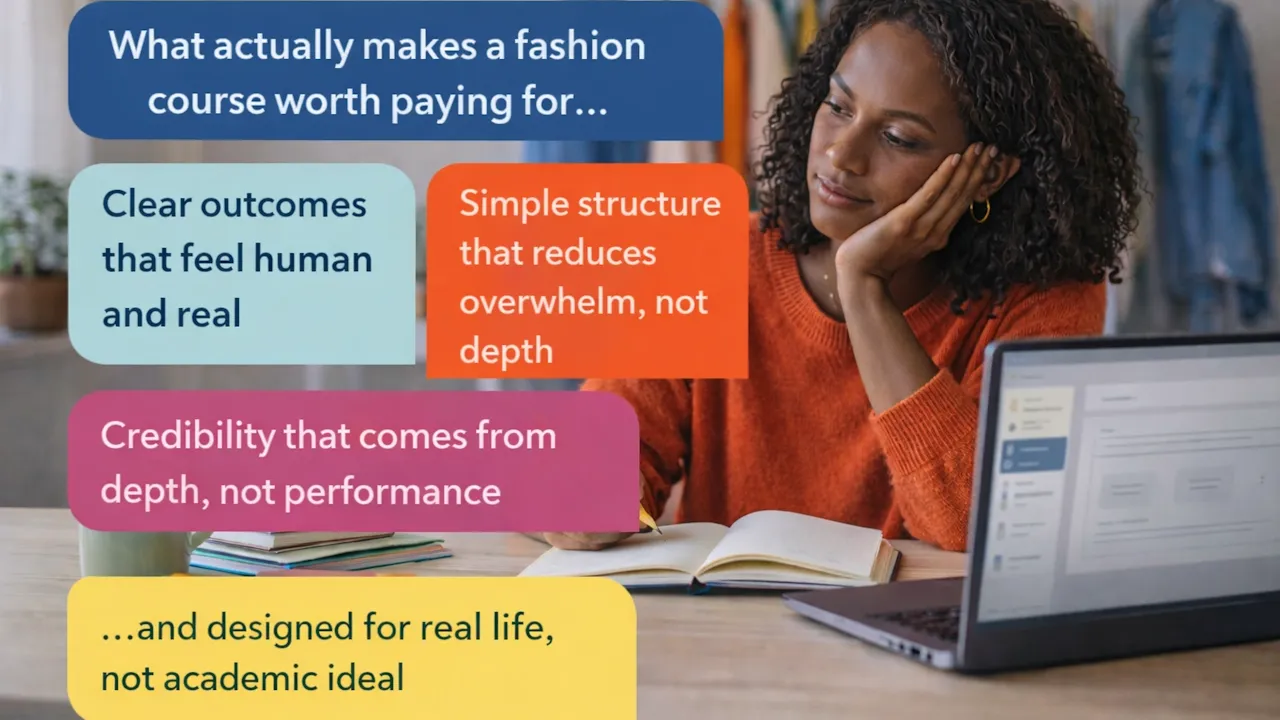
They lead with outcomes that feel human and recognisable.
Not:
“Introduction to Fashion Styling”
But:
-
Designing a capsule wardrobe that clients actually wear
-
Turning fashion education into paid consultancy work
-
Moving from graduate uncertainty to professional confidence
When someone can see themselves on the other side of the course, trust rises.
And when trust rises, commitment follows.
Structure Is Where the Real Value Lives
This is the part that many experienced experts underestimate.
You might feel that your value lies in your depth, and it does, but for learners, value often shows up as relief.
A good course:
This isn’t about dumbing anything down.
It’s about thinking about your learners, so they don’t have to hold everything at once.
Ironically, the more expertise you have, the more powerful this kind of structure becomes.
Authority Doesn’t Need Performance
One of the biggest misconceptions about online courses is that they require energy, charisma, or constant visibility.
They don’t.
For many fashion professionals, authority comes through:
-
Calm explanation
-
Thoughtful sequencing
-
Clear examples
-
Professional restraint
A course that reflects this tone often feels more credible and more premium than something loud or over-produced.
You’re not competing with influencers.
You’re offering something different.
Real Life Matters More Than Perfect Study Conditions
The best fashion courses assume learners are busy.
They’re already working. Teaching. Studying. Parenting. Building careers.
So effective courses:
This respects adult learners — and it increases completion far more than “motivation” ever could.
The Course as a Long-Term Asset
Perhaps the most important shift is this one.
A well-designed fashion course isn’t a one-off project.
It’s a professional asset.
It can:
-
Support your teaching
-
Strengthen your consulting work
-
Act as a credibility anchor
-
Create income stability alongside everything else you do
It’s not a pivot away from your work.
It’s a foundation under it.
Why This Matters Now
Fashion expertise hasn’t lost its value.
But value only holds when it’s visible, structured, and accessible in ways that match how people learn today.
An online course isn’t about chasing trends.
It’s about protecting your knowledge from being diluted, ignored, or exhausted out of you.
And when done properly, it gives you:
Which, frankly, is something fashion professionals have earned.
In Part 3, we’ll look at why many fashion courses fail, and how experienced experts can avoid those traps entirely.
If you haven't read Part 1 yet, here is the link.
We would love to chat with you about any ideas you might have for an online course, and offer a complimentary 30-minute call to discuss or answer any questions.