The Gap Between Owning an Idea and Getting It Made.
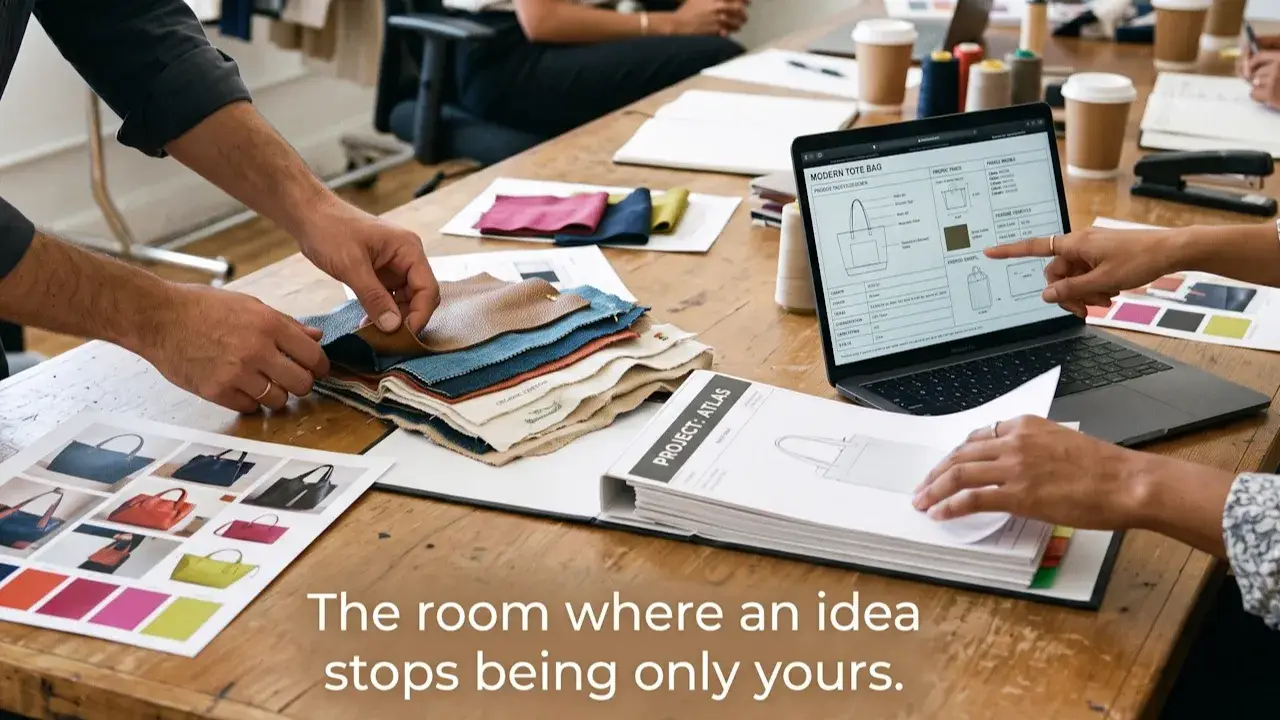
Fashion University hands you a very particular kind of authority. Your final collection belongs entirely to you: the references, the fabric story, the reasoning behind every seam you sew. When a tutor questions a choice in critique, you're expected to hold your ground and talk them round, not just fold. That instinct gets rewarded for four years, and then becomes one of the unspoken measures of talent on a design course: how convincingly you can defend your own vision in a room full of people picking it apart.
A small study actually backs this up. Researchers sat down with six design students and asked them what critique meant to them, and almost every one described it the same way: a stage for their own vision, somewhere to prove they were clear-sighted, street smart, creative. It's not a big study, and it's general design education rather than fashion specifically, but anyone who's sat in a crit will know exactly what I mean.
Then comes your first real design meeting, and the room is full of people who were never your examiners.
A merchandiser watches margin before anything else. A technician working out how your seam is actually built, not just how it photographs. A sourcing manager who already knows your colour plan won't fit the supplier minimums. Maybe a buyer somewhere down the line, whose customer you've never met and whose taste nobody ever taught you to think about. None of them sat in your crit room. None of them owes your vision a thing. They care whether the idea survives contact with a cost sheet and a delivery date.
Nobody warns you how disorienting that is. It's not that the industry is unkind; most people in that room are simply doing their jobs well. It's that everything you spent four years learning was built around a version of authorship that doesn't exist anywhere outside education. University teaches you to own an idea. Industry teaches you to let it be shared, questioned and reshaped by people whose expertise is completely different from yours, and just as valid.
Fashion also has evidence for this. A 2023 study followed forty senior fashion design and merchandising students through a joint capstone project, and the ones who'd already had practice working across that line- design talking to merchandising- before they'd even graduated were the ones who carried more value into the workplace afterwards. The gap doesn't close by accident. It closes when someone puts you in that room early and on purpose.
This isn't really about discovering the industry is harder than the mood board suggested. Most graduates work that out in the first fortnight anyway. It's about discovering your training gave you the wrong relationship with your own work. You were taught to protect an idea, and now you need to learn how to let it go without losing your voice inside the process altogether, and that's a far more subtle skill than anyone ever names out loud.
The designers who get good at this aren't the ones who agree to every note without pushing back. They're not the ones still defending the original vision as if the crit room never ended either. They're the ones who work out, slowly, usually through a fair bit of friction, which parts of an idea genuinely matter and which parts were simply never challenged in the first place.
That's not something a mood board can teach you. It only becomes visible once your work is sitting in a room with people who have no reason to agree with you.
If you're early in your career and finding this harder than you expected, that adjustment is the skill. Nobody arrives already knowing which battles to fight. You learn it the way you learn pattern cutting, by getting it wrong in front of people more than once, until you can finally feel the difference.
What did your first proper design meeting teach you about your own work that university never did?
If reading this made you think about everything you've picked up over the years, on the shop floor, in the studio, in a hundred meetings just like the one above, and you've been wondering whether it's time to turn it into something proper- a course, a coaching offer, a way of passing it on- that's exactly what we build. Go to the link below and let's talk about what yours could look like.
Not Sure Where to Start?
Most of the educators I speak to have been thinking about this for longer than they'd like to admit. If that's you, a 30-minute conversation is often all it takes to get some clarity. I'll talk through your idea, your concerns, and whether now is the right time to move forward.
Thinking About Building an Online Course?
We write regularly about the real decisions involved in turning fashion expertise into online learning, what works, what doesn't, and what most people underestimate before they start. If you're considering this seriously, sign up and we'll send you practical, honest guidance as we publish it.
No noise. Just useful thinking for fashion professionals who are ready to do this properly.
We hate SPAM. We will never sell your information, for any reason.
Author