Your Expertise Is the Answer the Fashion Industry Has Been Looking For — It's Time to Share It
I want to start with something that has genuinely moved me.
Over the past few months, the response to my work at We Teach Fashion has been extraordinary. Literally hundreds of fashion professionals from across the world have reached out, from the UK, Europe, the US, Australia, the Middle East, and beyond. Designers, technologists, educators, buyers, stylists, photographers, brand consultants, people at every level and every stage of their careers, all responding to what we've been writing and sharing about the state of fashion education and the skills gap in our industry.
I have been, quite honestly, blown away.
And it has told me something important: this conversation matters. The things I've been writing about on my blog, the gap between what graduates know and what the industry needs, the untapped expertise sitting inside experienced professionals, the urgent need for practitioner-led learning, these are things people feel deeply. They recognise them, and they've lived them.
But it has also shown me something I need to address directly, with honesty and with real warmth, because I don't want anyone to feel misled or disappointed.
A significant number of the people contacting us are looking for work.
Some are experienced professionals who find themselves unexpectedly out of a job. Some are recent graduates who are struggling to secure that all-important first role. Some are talented, committed people who have been trying for months, in some cases longer, and are finding doors much harder to open than they expected.
Their messages are often heartfelt. Sometimes they're urgent. And every single one of them deserves a proper, honest response.
So let me be very clear, with as much kindness as I can put into words on a screen:
I do not have job placements. I am not a recruiter. We Teach Fashion is not an employment agency, and I cannot find you a position in the industry.
I know that may be disappointing to read if that's what you were hoping for. I'm truly sorry if our content gave the impression it might be otherwise. What I can do and genuinely want to do is offer advice. A conversation. A different perspective on where you might go from here.
Because here's what I've come to believe, after years in this industry and after reading thousands of messages from fashion professionals all over the world: the gap in this industry isn't just about employment. It's about knowledge. And for many of the people reaching out to us, the answer to their situation might not be a job; it might be something they build themselves.
More on that in a moment. But first, let me tell you a little about who I am and why I believe so passionately in what we do.
A Little About Me
I have a First Class BA in Fashion and Textile Design and the History of Art, and in my final year, even before I graduated, I was fortunate enough to be taken on by Roger Saul at The Mulberry Company Design Ltd, one of the most iconic British fashion brands of its era. It was an extraordinary place to begin a career, and I learned more in that time than I could have imagined.
But life, as it has a habit of doing, took an unexpected turn. I had an accident and damaged my back, an injury that has stayed with me every single day since, and that I have lived with in pain now daily for many years. It changed the course of what I could do physically, but it never once changed my passion for this industry or my determination to stay a part of it.
From there, I built my own accessory design business, taking everything I had learned and applying it on my own terms. And later, I moved into teaching fashion and textiles at some of the UK's top independent schools, where I discovered something that has driven everything I've done since: that passing knowledge on to the next generation is one of the most meaningful things any of us can do with the expertise we've spent a lifetime building.
I tell you this not to impress you, but to let you know that when I talk about the value of fashion expertise, yours, mine, anyone's, I am not speaking theoretically. I am speaking from a career that has taken me from the design studios of one of Britain's greatest fashion houses, through the realities of running my own business, through years in the classroom, and eventually here: to We Teach Fashion, and to this conversation with you.
I understand this industry. I understand what it takes to build real knowledge within it. And I understand, more than most, how easily that knowledge can go unshared and what is lost when it does.
Where This Really Started — At Home, With Our Daughter
When our daughter Tolmeia was twelve years old, we decided to home-educate her.
It wasn't a decision we took lightly. But we believed, deeply, that the most valuable education we could give her wasn't one defined by a curriculum written by people who had never met her; it was one built around who she was, what she was curious about, and where her extraordinary mind was already pointing.
Tolmeia was passionate about fashion from an early age. Not in a passive, consuming way, but in the way that some children are simply built for something. She wanted to understand how things were made. She wanted to know why some designs worked and others didn't. She asked questions that most adults in the industry hadn't thought to ask.
So I taught her.
I taught her everything I knew, designing, pattern cutting, how to research a project properly, how to cost it out, and how to develop an idea from a sketch into something that could actually go to market. We sat together for hours, working through things that I had spent my own career learning the hard way, and I watched her absorb it all and make it her own.
And here is the thing that struck me, even then: there was almost nothing available online to help us. No structured resources, no practitioner-led courses, no accessible way for a parent, even one with a fashion background, to find expert guidance for a child who needed more than what a school could offer. We were piecing it together from books, from my own experience, and from sheer determination.
That gap between what was needed and what existed online planted a seed that would eventually become We Teach Fashion.
One of my favourite memories from those years is what I call the 'Moof en Lief project', the sock project that started as a small creative exercise and grew into something that showed Tolmeia, for the first time, what it meant to take an idea all the way from concept to commercial reality. We researched the market together. We costed it out. We thought about the customer, the story, and the why behind the product. It was one of those rare moments where education and real life become exactly the same thing, and I still think about it whenever I work with a client who is discovering that feeling for the first time.
Italy, the Industry, and the Night the Earth Moved
As Tolmeia grew, so did her passion and so did her voice. She began writing publicly about fashion, ethics, and sustainability, and her blog, Tolly Dolly Posh, was building a remarkable following of young people who responded to her honesty and her curiosity.
We wanted to give her more. We wanted her education to go beyond what we could teach at home and to immerse her in the industry itself, in the places where fashion had its deepest roots.
So we went to Italy.
We spent time living and learning across the country, from the textile mills of Prato, where Tolmeia attended Fashion Revolution events and spoke with the designers and fabric producers who were keeping slow fashion alive in one of Europe's oldest textile districts, to the ateliers and studios where craft was not a concept but a daily practice. She met people who had spent their entire lives in this industry. She saw firsthand what it meant for knowledge to be passed down through touch, conversation, and the simple act of someone showing another person how something was done.
It was during this time that I sat down with a pattern cutter in his studio, a woman who had spent over thirty years working for some of the most respected ateliers in the country. Her hands moved as she talked about her work the way hands do when knowledge has become completely physical. When thinking and doing are no longer separate things.
At a certain point in our conversation, she said something quietly in Italian without drama, which I have thought about nearly every day since:
"I have tried to teach the young ones everything I know. But there are never enough hours. They come, they watch, they understand a little, then they go. And the next ones come. And I think: when I am gone, where does all of this go? Nobody writes it down. Nobody records it. It just disappears with me. And that, to me, is the real tragedy of our industry."
I haven't made my peace with that. And I don't intend to.
Then, in August 2016, everything changed in a single moment.
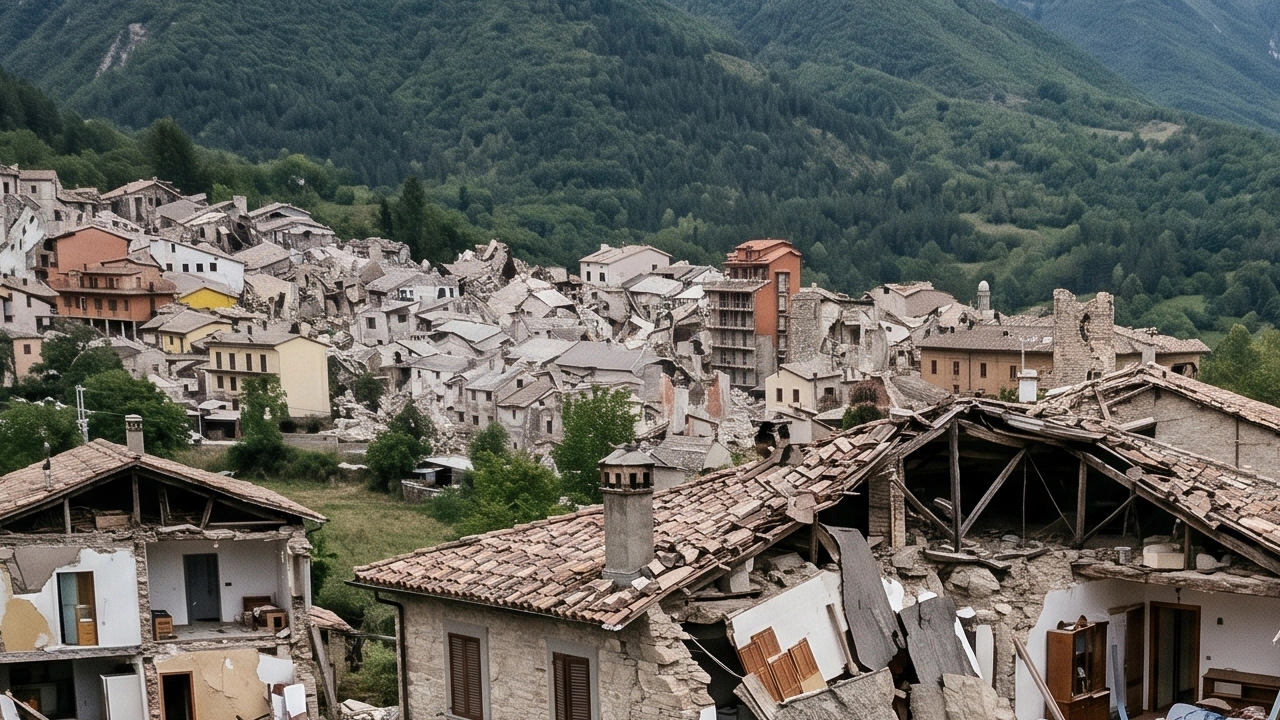
At 3:36 in the morning on the 24th of August, a 6.2 magnitude earthquake struck the Le Marche region of Italy, where we were staying. In a matter of seconds, no warning, no gradual build-up, the world we had built there came apart around us. Walls cracked. Things fell. Tolmeia, sixteen years old, scrambled under a desk in the pitch dark, shaking. We found our cat, Paloma, four hours later, hiding unharmed behind a sofa upstairs.
We were lucky. Others were not. The town of Amatrice, an hour and a half away, a place we had sat and had coffee in the previous winter, was destroyed.
We lost our home there. We lost the life we had been building in that country. And in the aftermath of that night, sitting outside under the stars while aftershocks rolled through the ground beneath us, I found myself thinking about everything we had come to Italy to find and what it would mean to make sure it wasn't lost.
What That Girl From the Kitchen Table Did Next
I want to tell you how this story ends. Because I think it matters enormously to everything I'm about to say.
That twelve-year-old at the kitchen table, the girl I taught to design, to cut a pattern, to cost a project and take it to market, the girl who had no conventional school, no standard curriculum, no traditional path through the fashion industry, grew into something quite extraordinary.
Tolmeia went on to channel her Italian experiences and her deep fashion education into a voice that the industry sat up and listened to. She joined Extinction Rebellion at London Fashion Week. She spoke at climate strikes. She attended Fashion Revolution events in Prato, standing in rooms with the makers and the manufacturers and asking the questions that needed asking.
And today? Today, Tolmeia Gregory is Head of Social and Visual Strategy at Clean Creatives in New York, one of the most respected organisations working at the intersection of creativity, ethics, and climate action. She is working at the highest level of her field, in one of the world's most competitive cities, doing work that is genuinely changing things.
You can find her at www.tolmeiagregory.com.
She didn't get there through a conventional education. She got there through her own determination and resolve, because someone took the time to teach her properly, with real knowledge, real projects, and real belief in what she was capable of.
I tell you this not to boast, though I won't pretend I'm an enormously proud mother, but because it is the most honest answer I can give to the question I hear most often:
"Does this kind of education really work?"
It works. I have the proof, and her name is Tolmeia.
Who am I talking to
Whether you are a fashion designer, a senior buyer, a garment technologist, a pattern cutter, a stylist, a trend forecaster, a textile designer, a visual merchandiser, a fashion lecturer, a costume designer, a fashion photographer, a retail consultant, a milliner, a footwear designer, a knitwear designer, a fashion editor, a PR coordinator, a sustainability lead, a sourcing specialist, an eCommerce manager, a colourist, a fashion illustrator, a brand consultant, a jewellery designer, a swimwear designer, a tailor, a couturier, a digital media specialist, an accessories designer, a production manager, or a merchandiser...
You have built something the world needs. Whether you are currently employed, recently made redundant, searching for your first role, or simply feeling unseen in an industry that doesn't always make it easy to be found, your knowledge has value. Real, commercial, life-changing value. And this post is about helping you understand how to use it.
The Skills Gap Is Real, and It's Getting Worse
Let me share some numbers: this isn't just a feeling; it's documented, researched, and increasingly urgent.
The BoF-McKinsey State of Fashion 2026 report found that over 68% of fashion employers now consider commercial and strategic fluency essential at the entry level, skills that most graduates arrive without, and that most institutions are still not equipped to teach effectively.
The World Economic Forum has reported that over 50% of all employees will need significant reskilling by 2025 as industries evolve and fashion, with its rapid pace of change across sustainability, digital, and global supply chains, is at the sharp end of that curve.
Research by the British Fashion Council has consistently highlighted that the gap between what design schools produce and what the industry actually needs is widening. Technical skills, commercial awareness, factory communication, and margin thinking are not extras. They are foundations. And they are missing.
As I explored in our blog post 'Why Fashion's Skills Gap Won't Be Fixed by Universities', the knowledge that would fix this problem isn't sitting in an academic journal. Universities will spend years redesigning a curriculum before anything substantially changes. Large brands will commission a report, hold a roundtable, and move on. Neither moves at the speed the industry needs.
The knowledge that would genuinely close this gap is sitting inside working practitioners. Inside people like you.
The senior designer who knows exactly how a commercial collection comes together. The stylist who has spent fifteen years developing an instinct that no textbook can replicate. The pattern cutter whose decades of technical knowledge are genuinely at risk of being lost. The garment technologist who can spot a costly sampling mistake before it ever reaches the factory floor.
That expertise exists. The gap exists. And between them sits an extraordinary opportunity.
A Word to Those Who Are Struggling to Find Work
If you're one of the many people who reached out to us because you're out of work, whether you're an experienced professional who has found themselves unexpectedly without a role, or a graduate who is finding the industry harder to break into than you'd hoped, I see you. I hear you. And I want to say something, I mean genuinely:
The difficulty you're experiencing in finding work is not a reflection of your talent or your value.
The fashion industry is going through one of the most significant periods of disruption in its history. Retail restructuring, supply chain shifts, the rise of digital, and sustainability pressures are reshaping where the jobs are, what they look like, and how people find them. Many talented, qualified, experienced people are navigating this right now. It is hard. And it is not your fault.
I cannot place you in a role. I want to be honest about that, because false hope serves no one. But what I can do is offer you a different question to sit with:
What if the job you're looking for is one you could create for yourself?
Just last week, I received a message from a pattern cutter based in Dubai, experienced and talented, who had been out of work for eight months. She wrote:
"I have been sending CVs every week. Nobody is responding. I feel like I have so much to give and nowhere to give it. I didn't know there was another way."
There is another way. And if that resonates with you, I would genuinely love to have that conversation. No obligation and absolutely no pressure, just an honest discussion about your situation and whether there's a different path forward. Reach out at www.weteachfashion.com/contact and tell me a little about where you are. I'll come back to you personally.
The Science of Why Your Knowledge Is So Valuable
There's a concept in cognitive science called tacit knowledge. Knowledge so embedded through experience that the person holding it often doesn't even recognise it as knowledge anymore. It's the instinct. The pattern recognition. The ability to look at a collection and know something is off before you can articulate exactly why.
The psychologist Michael Polanyi, who first described this concept, put it beautifully: "We know more than we can tell."
When I think about that Italian pattern cutter in her studio, hands moving as she spoke, thirty years of knowledge living in his fingers and her eye, that is tacit knowledge in its purest form. And when I think about teaching Tolmeia at home, passing on everything I knew about design and pattern cutting and costing and taking something to market, that was tacit knowledge being deliberately, lovingly transferred before it had the chance to be lost.
Research published in the Journal of Educational Psychology has consistently shown that learners retain significantly more from instructors who combine conceptual knowledge with real-world experience. Students don't just want theory; they want someone who has actually done the thing. Someone who can say "Here's what really happens when..."
A 2020 study by the Online Learning Consortium found that learners who study with practitioner instructors, people with active industry experience rather than purely academic backgrounds, report significantly higher satisfaction, higher completion rates, and higher confidence in applying what they've learned.
The industry needs you. The learners want you. The science backs it up.
The Market That's Waiting
Online learning has grown by 900% since 2000. Let that land for a moment.
The global e-learning market is now forecast to reach $400 billion by 2026, according to Global Market Insights. And the fastest growing segment isn't academic qualifications or corporate compliance training. It's specialist, practitioner-led knowledge from people with genuine industry experience.
Forbes reported in 2023 that the creator economy, people selling their expertise and knowledge online, is now worth over $250 billion globally, growing faster than almost any other sector of the digital economy.
When I think about the moment we were sitting in Italy, pieces of a home around us, deciding what to carry forward, I knew the answer was never to let knowledge stay trapped in a room. Online learning is the most powerful vehicle we have ever had for making sure it doesn't.
"But Is My Knowledge Really Worth Sharing?"
I hear this question constantly. And I want to address it directly because it's the single biggest thing holding back brilliant people.
The answer is yes. Unequivocally, yes.
I recently spoke with a senior fashion educator with 23 years in the industry and decades of commercial experience. She had been considering launching an online course for three years. Three years. Not because she lacked confidence in what she knew. But because every time she sat down to figure out how to actually do it, she felt immediately out of her depth. The tech. The platforms. The sales pages. The launch strategy. It all piled up before she'd even started, and she quietly closed the laptop.
I understand that feeling more than most. When I was teaching Tolmeia at home all those years ago, there was almost nothing online to support us. We built it ourselves, from scratch, because we had to. That experience taught me something I have never forgotten: the absence of the right resource doesn't mean the knowledge isn't there. It means someone needs to build the bridge.
That is what we do. And it's exactly what Mark and I are here for.
What Our Clients Say
"Mark and Cheryl will skyrocket your business, simple as that. I started working with them in January. I did not have either a website or a product ready to be sold. Within two months, we had everything up and running, and I have now generated over 100,000 euros in online sales. It has literally changed my business and my life." — Davide D.
"It took me some time to decide on building an online course. I looked at dozens of providers and Mark and Cheryl stood head and shoulders above everyone. They are FIRST CLASS in everything they do, and their passion to help you deliver an outstanding online course is truly wonderful. By far the best people you will find in this field. It was a great privilege and I cannot recommend them highly enough." — Tony N.
"Mark was a true professional and working with him to create my first online course and sales page was a very enjoyable process. As a non-techie person, I had many questions and made various changes throughout — and Mark was always understanding and patient. He offered constructive feedback and expertise I am very grateful for. I would highly recommend his services without hesitation." — Louise I.
The Thing Nobody Tells You About Fashion Expertise
There's a line from our blog post 'Most Fashion Expertise Dies in a Room' that I keep returning to. And I think about that Italian pattern cutter every time I read it.
The Renaissance lasted because people wrote things down. They recorded their methods. They passed their knowledge on properly through workshops, through apprenticeships, through the deliberate act of teaching what they knew to the people who came after them.
I tried to do that for Tolmeia. From a kitchen table in England to the textile fairs of Prato. From a sketchbook and a sock project to a young woman working at the forefront of her industry in New York City. And she was able to secure all this on her own, without any formal qualifications or a University degree; she just knew herself inside and out.
None of that happened by accident. It happened because someone took the time to pass something on.
Your expertise deserves the same. Not just for the income it could generate, though that matters enormously. But because the next generation of fashion professionals genuinely needs what you know. An online course is the most powerful, most scalable, and most lasting way to ensure it reaches them.
How We Help You Do This
At We Teach Fashion, we specialise in one thing: helping fashion industry professionals turn their hard-won expertise into online courses and coaching programmes that genuinely reach people — and generate a real, lasting income.
Our Done-For-You Service — You bring the expertise. We build everything else. Your full branded platform, your complete launch funnel, your course structure, all the technical setup, and ongoing support. Most clients are launch-ready within 4–6 weeks. Everything we build is 100% yours, forever. Find out more here.
Personal Coaching — We walk you through every stage at your own pace, with screen sharing, unlimited questions, and an encouraging guide by your side at every step. No tech experience needed. No teaching qualification required. Just your expertise and your story. Find out more here.
We also offer:
- Online Course Health Check — if you've started but feel stuck
- Kajabi Support — technical help for Kajabi users
- Tailor-Made Service — bespoke, fixed-fee support for specific needs
- FashionPro Masterclass — self-study, at your own pace
Your Questions Answered
I don't have a big audience — can I still do this? Absolutely. Many of our most successful clients started with no email list, no social following, and no existing student base. We build your launch funnel specifically to help you find your first students. You don't need an audience to start; you build one as you go.
Do I need to be tech-savvy? Not even slightly. That's precisely why our Done-For-You service exists. We handle every technical element so you don't have to think about it.
I've never taught before — does that matter? Far less than you think. What matters is what you know, and you know an enormous amount. Teaching is a craft, and it's one we can guide you through step by step.
What if I've already started a course and got stuck? This is more common than you'd believe, and it's exactly what our Online Course Health Check is designed for. We'll review what you have, identify what's missing, and give you a clear, practical plan to move forward.
How long does it take to launch? With our Done-For-You service, most clients are launch-ready within 6–8 weeks. With coaching, the timeline is flexible and built entirely around you.
Is this only for people who want to earn money from it? Not at all. Some of our clients are driven primarily by the desire to pass on their knowledge, preserve what they've built, and share it with the people who need it most. The income is wonderful, but the purpose behind it is often what gets people started. Both are completely valid reasons to do this.
Something Very Exciting Is Coming...
Before I go, I want to leave you with one more thing, and I'll admit, I'm finding it quite hard to contain my excitement about this one!
Over the coming weeks, Mark and I will be announcing a brand-new initiative we have been quietly working on behind the scenes. It is something we are enormously proud of, and it goes hand in hand with everything we have been talking about in this post: bridging the gap, sharing expertise, and ensuring that the knowledge this industry holds in abundance finally reaches the people who need it most.
I'm not quite ready to share the details just yet, but I promise you, it will be worth the wait.
If you want to be among the first to hear about it when we do announce, the best thing you can do is make sure you're on our mailing list or following us on our blog at www.weteachfashion.com/blog. We will be sharing everything there first.
Watch this space. This is just the beginning.
Before You Go
If you reached out hoping for a job, I'm genuinely sorry I can't give you that. But I hope this post has offered something different: a new way of looking at what you have, and what it could become.
And if you've been sitting on an idea, a course you've been meaning to build, a body of knowledge you've been meaning to share, please know that I understand exactly what it takes to begin. I've been there, at the kitchen table, figuring it out from nothing. And I've been in Italy, sitting in the rubble of something I loved, deciding what to carry forward.
What I carried forward is this. And I'd love to help you carry yours forward, too.
www.weteachfashion.com/contact
With all my love, Cheryl Gregory, Co-Founder, We Teach Fashion www.weteachfashion.com | Our Blog
Sources: BoF-McKinsey State of Fashion 2026; World Economic Forum Future of Jobs Report; Global Market Insights E-Learning Market Report; British Fashion Council Skills Research; Forbes Creator Economy Report 2023; Online Learning Consortium Learner Satisfaction Study 2020; Michael Polanyi, 'The Tacit Dimension' (1966); Journal of Educational Psychology.
Not Sure Where to Start?
Most of the educators I speak to have been thinking about this for longer than they'd like to admit. If that's you, a 30-minute conversation is often all it takes to get some clarity. I'll talk through your idea, your concerns, and whether now is the right time to move forward.
Thinking About Building an Online Course?
We write regularly about the real decisions involved in turning fashion expertise into online learning, what works, what doesn't, and what most people underestimate before they start. If you're considering this seriously, sign up and we'll send you practical, honest guidance as we publish it.
No noise. Just useful thinking for fashion professionals who are ready to do this properly.
We hate SPAM. We will never sell your information, for any reason.
Author